Why Does Nobody Talk About GPT-5.6 Terra? The Silent AI Revolution of 2026
It’s 2026, and the biggest AI story isn't a chatbot. It's GPT-5.6 Terra, an invisible engine powering our world's most complex systems. So, why does nobody talk about GPT-5.6 Terra? We explain why the most revolutionary AI is the one working in silence.
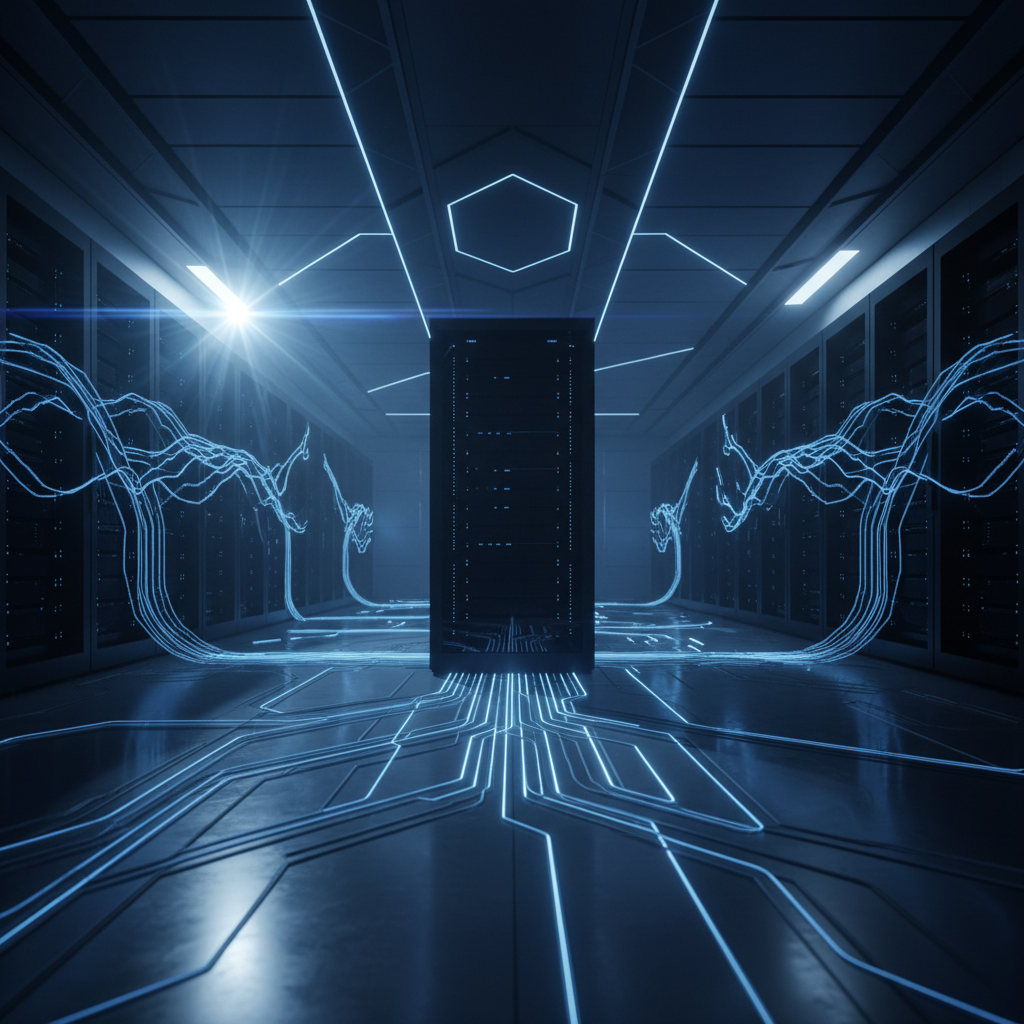
TL;DR: GPT-5.6 Terra is intentionally un-hyped. It's not a consumer-facing chatbot but a specialized, systems-level model designed to orchestrate complex, long-running autonomous tasks. Its success is its invisibility, making it the quiet engine of the 2026 industrial world, not the star of a flashy demo.
01Key Takeaways
- A Tool, Not a Toy: GPT-5.6 Terra is an infrastructure-level AI, functioning more like an operating system for autonomous agents than a conversational partner. Its purpose is orchestration, not content creation.
- Statefulness is a Superpower: Unlike its stateless chatbot cousins, Terra's architecture is built around maintaining a persistent, complex 'world model' over long durations, which is critical for managing real-world systems.
- The "Boring" AI Moat: The real economic battle in AI is shifting from consumer-facing services to owning the foundational layer for industrial and logistical automation, an area where models like Terra are mission-critical.
- Invisible Success: The reason nobody talks about it is because when it's working perfectly, nothing happens. It prevents failures, optimizes flow, and manages complexity silently in the background of major industries.
The year is 2026. The Port of Long Beach is a silent ballet of steel. Gantry cranes, massive as dinosaurs, glide along rails, plucking containers from a newly arrived ship with impossible precision. Below, a fleet of autonomous electric trucks weaves through the stacks, a perfectly choreographed swarm delivering containers to their designated spots for rail transport. There are no shouts, no frantic radio calls, no near-misses. It just… flows. The entire operation, involving thousands of moving parts and variables changing by the second, is being conducted by an AI. But it's not the AI you've been reading about.
This isn't the work of some flashy, conversational super-intelligence. This is the domain of a quiet, background process, a model designed for one thing: unerring, long-term systems management. This raises the critical question we're hearing from industry insiders: why does nobody talk about gpt-5.6 terra? While the world remains obsessed with AI that can write poetry or generate videos, the most profound shift is happening in silence, powered by this new class of workhorse models.
02The Ghost in the Machine: What Exactly Is GPT-5.6 Terra?
After the initial splash of GPT-5 in late 2024, the public expected a linear path of progress: better chatbots, more creative image models, and more convincing video generation. And while those iterative updates (like the current GPT-5.5 series) have continued, OpenAI and its competitors have been quietly running a parallel development track. GPT-5.6 Terra is the flagship product of that track.
It’s not an upgrade to the chatbot you use for brainstorming. It’s a completely different phylum of AI.
Not Your Grandfather's GPT
Think of a standard LLM like GPT-5.5 as a brilliant but forgetful consultant. You can give it a task, and it will perform it with incredible skill based on the context you provide. But once the task is done, its memory of the interaction is effectively gone. Each new conversation starts from a near-blank slate. This is a feature, not a bug, for most consumer applications. It’s called being 'stateless.'
GPT-5.6 Terra is the opposite. It is profoundly 'stateful.' It's designed not for conversations but for campaigns. Its core function is to build and continuously update a complex, high-dimensional model of a system—a supply chain, an energy grid, a fleet of robots—and manage it over hours, days, or even weeks. It doesn't just respond to prompts; it observes, predicts, and acts within a persistent operational context.
A Focus on "Statefulness" and Long-Term Memory
The architectural choices in Terra reflect this mission. Its training data isn't just a vast scrape of the internet. It's heavily weighted towards structured data, time-series logs, engineering schematics, sensor readings, and simulated complex systems. It has learned the language of logistics, physics, and resource flow, not just the language of humans.
Its memory isn't a simple context window. It’s a hierarchical system. There’s a short-term 'situational awareness' buffer, but also a long-term 'state repository' that it continually prunes and updates. This allows it to do things a conversational AI simply can't, like remembering the maintenance schedule of a specific crane (Crane 7B) and factoring that into its operational plan for the next 72 hours. This is the core of what makes it a true autonomous agent orchestrator.
03Terra vs. The World: A Different Breed of Intelligence
The reason Terra gets so little public attention is that its metrics for success are alien to the average user. It's not judged by the cleverness of its poetry or the coherence of its essays. It's judged on throughput, efficiency, downtime reduction, and predictive accuracy. It's the plumber of the AI world: nobody thinks about it until the system breaks, and its entire job is to ensure that never happens.
To put it in perspective, let's compare it to the more familiar models of the 2026 landscape.
| Feature | GPT-5.5 (Mainstream) | Claude 4 Series (Enterprise) | GPT-5.6 Terra (Systems) |
|---|---|---|---|
| Primary Use Case | General-purpose content, chat, creative assistance. | High-stakes knowledge work, legal, medical, safety analysis. | Autonomous systems orchestration, logistics, process control. |
| Core Strength | Creative and linguistic flexibility. | Reasoning, instruction following, and constitutional alignment. | Long-term state management, multi-agent coordination, reliability. |
| Training Data | Broad web text, books, images, video. | Curated enterprise documents, legal texts, vetted knowledge bases. | Sensor data, time-series logs, simulation environments, schematics. |
| User Interface | Chat windows, creative suites. | APIs, document analysis tools. | SDKs, APIs, dashboard integrations (for monitoring). |
| Success Metric | User engagement, helpfulness ratings. | Accuracy, safety, task completion success. | System efficiency, uptime, resource cost reduction. |
This table makes it clear: you wouldn't use a wrench to write a novel, and you wouldn't use a poet to fix your plumbing. Terra isn't competing with other LLMs; it's competing with legacy industrial control software, human-led operations teams, and the chaos of complex, un-optimized systems.
04Under the Hood: The Technical Architecture That Makes Terra Different
We don't have the full schematics—OpenAI is notoriously tight-lipped about its most advanced architectures—but from talking to developers in its private beta, we've pieced together some of the key components that distinguish Terra.
Hierarchical Processing Layers
Unlike the monolithic transformer architecture of earlier models, Terra appears to use a hierarchical structure.
- The Perception Layer: This layer ingests and normalizes massive streams of real-time data—everything from GPS coordinates of a truck fleet to pressure readings in a pipeline. It's a firehose of information that is processed and compressed into a coherent 'present moment.'
- The World Model Layer: This is the stateful core. It takes the perception data and integrates it into its long-term model of the system. It's constantly running simulations, predicting future states, and identifying potential conflicts or inefficiencies. This layer is likely powered by a novel architecture that blends transformers with state-space models, a concept explored in papers like the Mamba architecture.
- The Strategy Layer: This is the decision-making engine. Based on the world model's predictions and a set of defined goals (e.g., "minimize fuel consumption while meeting all delivery windows"), this layer generates a high-level plan.
- The Action Layer: The strategic plan is translated into concrete commands for individual agents (e.g., "Truck #A452, proceed to loading bay 7; Crane #C12, prepare to unload container #X987"). This layer communicates via specialized APIs to the hardware doing the work.
The "Persistence Engine"
The true innovation seems to be what developers are calling the "Persistence Engine." This is the mechanism that allows the World Model Layer to operate over long time horizons without succumbing to catastrophic forgetting or state drift. It appears to be a sophisticated combination of data indexing, summarization, and a form of "AI garbage collection" that retires irrelevant old data while retaining causally important events.
This is a massive leap from the context windows of even a year or two ago. For anyone building serious automation, this move from ephemeral context to persistent state is the single biggest unlock in the history of commercial AI. It's the difference between a smart tool and a true autonomous partner.
05Real-World Use Cases (That You'll Never See)
The applications for Terra are vast, but they share a common trait: they are largely invisible infrastructure.
Autonomous Logistics and Supply Chain Management
This is the flagship use case. The Port of Long Beach example is just the beginning. Terra-like models are being deployed to manage entire national and international supply chains. They predict shipping lane congestion based on weather patterns, re-route freight in real-time to avoid disruptions, and manage warehouse inventory with a level of precision that eliminates waste. The result isn't a flashy new product, but cheaper goods, fuller shelves, and a more resilient global economy. This is a far cry from simple coding agents that just write software; this is about making the physical world run on code.
Smart Grid and Utilities Optimization
Energy grids are another prime target. A Terra-class model can monitor a state-wide grid, predicting demand spikes based on millions of variables (weather, local events, industrial activity) and dynamically routing power from various sources (solar, wind, traditional plants) to ensure stability and minimize costs. When it works, your lights don't flicker during a heatwave. You don't see the AI; you just experience its effect as seamless reliability. Google DeepMind has published work on similar, earlier-stage concepts, but Terra aims to make this a turnkey solution.
Decentralized Autonomous Organizations (DAOs)
An emerging and more speculative use case is in the management of large-scale DAOs. These decentralized entities often struggle with efficient resource allocation and complex governance. A model like Terra could act as an impartial, hyper-efficient executor of the DAO's stated goals, managing treasury funds, allocating grants, and running operational tasks based on rules encoded in a smart contract. It could be the missing link that makes complex DAOs truly viable.
06The Economic Moat: Why Big Tech is Pouring Billions into "Boring" AI
While the media breathlessly covers the latest chatbot feature, the real chess match is for the infrastructure layer. Companies like OpenAI, Google, and Anthropic understand that the market for consumer AI is fickle. But the company that provides the "operating system" for the world's industries has a customer base locked in for decades.
As noted by publications like The Verge, the focus often lands on generative models. However, the investment in these underlying systems is arguably larger and more strategic. Owning the Terra layer is like owning the TCP/IP protocol for an automated world. It's a foundational technology that becomes an indispensable, non-negotiable part of how business is done. This is the ultimate economic moat, and it's why billions are being spent to perfect an AI that most people will never directly interact with.
This is a long-term play. It's about building the tools that will build the future, a core part of our philosophy here at AgentsDesk.
07The Challenges and Risks of Invisible Autonomy
This silent revolution is not without significant risk. When a system is so effective that it becomes invisible, it also becomes dangerously easy to ignore.
The Problem of "Silent Failure"
What happens when a model like Terra makes a subtle error in its world model that goes undetected for weeks? A chatbot spouting nonsense is obvious. A logistics AI slowly mis-calibrating inventory levels across a continent could lead to a catastrophic failure that only becomes apparent when it's too late. The very persistence that makes Terra powerful also makes its potential errors more insidious.
Auditing and Accountability
How do you audit a decision made by an AI managing a billion-variable system? The "black box" problem is magnified a thousand-fold. If a Terra-managed grid fails, leading to a blackout, determining causality and accountability is a monumental technical and legal challenge. Organizations like Stanford's HAI are working on frameworks for this, but the technology is far outpacing the oversight.
The Deskilling of Critical Infrastructure Roles
As these models take over the cognitive load of systems management, there's a real danger that the human expertise required to run these systems manually will atrophy. What happens if a Terra instance has to be taken offline in an emergency? Will there be any humans left who understand the system well enough to take the helm? This is a question that keeps a lot of us who work in the field awake at night. If you're curious about our team's background, you can learn more on our about page.
08FAQ
Is GPT-5.6 Terra a real model from OpenAI?
This article is a speculative analysis based on a 2026 timeline. While the specific name "GPT-5.6 Terra" is a conceptual handle for this piece, the development of specialized, stateful, systems-level AI models by major labs like OpenAI is a very real and active area of research and development. We're describing a trend that is already in motion.
How is Terra fundamentally different from a standard GPT-5?
The key difference is statefulness. A standard GPT model is stateless; it handles one interaction at a time with limited memory. Terra is stateful, designed to maintain a persistent, complex model of a system over long periods, making it suitable for continuous, autonomous management tasks.
Can I use GPT-5.6 Terra for creative writing or chatting?
No. It would be exceptionally bad at it. Its training and architecture are hyper-specialized for interpreting sensor data, managing logistics, and optimizing systems, not for understanding linguistic nuance, poetry, or human-like conversation. Using it for chat would be like using an industrial crane to paint a miniature.
What skills are needed to work with models like Terra?
Instead of prompt engineering, the key skills are systems engineering, data science, control theory, and simulation. Professionals will work on defining the AI's goals, designing the data pipelines that feed it, and creating sophisticated simulation environments to test and validate its behavior before deployment.
What are the main safety concerns with this type of AI?
The biggest concerns are silent failures (subtle errors that compound over time), the difficulty of auditing its complex decisions, ensuring robust security against adversarial attacks on its data inputs, and the societal impact of deskilling the human workforce in critical infrastructure sectors.
Why the name "Terra"?
In our conceptual framing, "Terra" signifies its connection to the physical world—the earth. Unlike models that live purely in the digital realm of text and images, Terra's purpose is to understand and manage tangible, real-world systems like logistics, energy, and robotics.
09The Revolution Will Not Be Televised
So, why does nobody talk about gpt-5.6 terra? Because it's not a showman. It's a workhorse. Its purpose isn't to dazzle you with a demo; it's to create a world that is more efficient, more reliable, and more resilient. The chatbot race and the generative media frenzy are exciting, but they are ultimately a sideshow. The real, lasting revolution in AI is happening in the unglamorous, high-stakes world of industrial automation.
The most powerful AI agents are the ones you never see. They are the silent conductors of our complex world, and their impact will be far greater than any conversation you could ever have with a chatbot. The headlines may belong to the poets, but the future belongs to the plumbers.
If you want to keep track of the AI that's actually changing the world, not just the AI that's making noise, you're in the right place. Contact us or subscribe to AgentsDesk for hands-on analysis of the agents that matter.
Topics
One click helps another builder find this — thank you.
Found this useful?
Share it using the buttons above and subscribe for the next one.
Related deep-dives
 Autonomous Agents
Builders vs. Users: The Biggest Problem With AI in 2026
It's August 2026, and the AI hype train has derailed. The biggest problem with AI in 2026 isn't AGI; it's the massive disconnect between the people building AI and the people meant to be using it. Here's a look at why 95% of pilots fail and what users actually want.
 Autonomous Agents
How to Give AI Agents a Boss: Our 2026 Supervisor Agent Playbook
I saw that Reddit thread, "I Gave My AI Agents a Boss - Now They Run Themselves." We did that six months ago. After one $3,000 accidental API bill, here's our actual playbook on how to give AI agents a boss—the supervisor agent architecture that works.
 Autonomous Agents
Best Free Hugging Face API Keys for Medical AI Agents (2026 Guide)
It's 2026, and building a medical AI agent is more accessible than ever, but where do you start? We cut through the hype to find the best free Hugging Face API keys and models for your projects. This is your practical guide to getting started without breaking the bank.